125 Washington Avenue, (Not staffed Full Time)
Po
Box 267 Lavallette, NJ 08735
Phone 732-793-6900
(Non Emergency) Fax 732-830-7135
Proudly Serving The Borough of Lavallette since 1923

911 Emergency
Lavallette Volunteer Fire Co. No. 1


Lavallette Fire Company Regrets to Announce
The Passing of
Michael Franzoso
Fire Services To Be Announced
|
Line Officers |
|
| Chief | Arthur Reece |
| Assistant Chief | Joseph Lord |
| Captain | Christian LaCicero |
| 1st Lieutenant | Justin Lamb |
| 2nd Lieutenant | Joseph Giampetrio |
|
|
|
| President | Arthur Reece |
| Vice President | F. Coleman Brice |
| Treasurer | Bob Lamb |
| Assistant Treasurer | Christian LaCicero |
| Secretary | William Reed |
| Recording Secretary | Joseph Lord |
Any person wishing to join the fire Department and
help your community can
call 732-793-6900.
All training will
be provided by the Lavallette Fire Co.
Remember
To
Check &
Change
Your
Smoke
Detector
Batteries

For the greatest protection, install a smoke detector on every level
of your home and inside each sleeping area. Also, develop an escape
plan and make sure every family member knows what to do if the fire
alarm sounds.
Test smoke detectors at least once each month
to ensure that they are working properly. Vacuum the dust from
inside the detector at least once every year. Batteries in
battery-operated detectors should be changed twice a year or
whenever a detector “chirps” to signal low battery power.
Never “borrow” a smoke detectors battery for another use. A disabled
detector cannot save your life. In addition, smoke detectors should
be replaced every 10 years or according to the manufacturer’s
specifications.
![]()
Upcoming Events!
Fire Safety Information
A Fireman's Prayer
When I am called to duty, God,
Whenever flames may
rage;
Give me strength to save some life,
Whatever be its age.
Help me embrace a little child
Before it is too late
Or save an older person
From the horror of that fate.
Enable me to be alert
And hear the weakest shout,
And quickly and efficiently
To put the fire out.
I want to fill my calling
And to give the best in me
To guard my every neighbor
And protect
his property.
And if, according to my fate,
I am to lose my life,
Please bless with your protecting
My children and my wife.
- Author Unknown
History of
the Lavallette Volunteer Fire Company


Meeting Minutes and Roster from first meeting
In the early days of Lavallette, fire protection consisted of a hand-powered chemical wagon'. It was housed in a building situated on a lot located at Reese and Grand Central Avenues owned by Mr. Charles Garibaldi. The rim of a huge locomotive wheel hung suspended from railroad ties near this building, and, in case of fire, an alarm was given by striking this rim with a sledge hammer which hung nearby. Every able bodied male resident of Lavallette within hearing distance would respond. The old locomotive rim was moved in 1959 from the driveway property of Charles Garibaldi, Jr., where it had been buried for many years, to its present location in front of the firehouse.
On February 10, 1923 , a group of twenty-five men met in the Lavallette Borough Council chambers for the purpose of organizing a volunteer fire company. The Council chambers were located in Applegate's Hotel on the site of the present Crab's Claw Inn. At this meeting the Lavallette Volunteer Fire Company NO.1 was formed.
Much was accomplished during the months following
the first organizational meeting. In
March the first bylaws of the company were approved and the first
slate of officers was elected. A lot upon which to build a firehouse
was purchased for $465.00. The location of this lot is known now
as
105 Reese Avenue
. In October 1923, the Borough's first truck, a Reo, was delivered.
It cost $4,500.00. On
January 19, 1924
, the Fire Company held its first Oyster Supper, founded by William
Nugent, and realized a profit of $450.00.
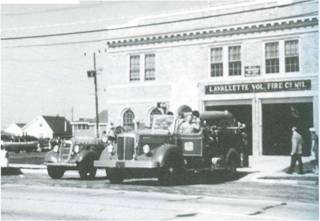
1935 Ford and 1949
Mack pumpers in front of firehouse, now Borough offices, 1955
In its formative years, the Company was assisted by a ladies' auxiliary. The ladies were a great help in the early development of the Company.
When the present Borough Hall was erected in 1928, the Fire Company was allotted space in the new building for a meeting room and engine room. The Company sold its lot on Reese Avenue for $1,000.00. This money was turned over to the Borough in return for the company's new quarters.
Also in 1928, steps were taken to have members within proper age limits join the State Fireman's Association. This required that the Company be placed under the control of the Borough Council in regard to approval of new members and elected officers and disposition of certain equipment. Since that time the Company has been financed partially through budget appropriations of the Borough Council.
The steady progress of the Company during its early years slowed to a struggle for survival with the advent of the Great Depression in the 1930's. In 1932, an Ahrens Fox fire truck that had been bought in 1930 was returned to the company from which it had been purchased. The Fire Company was unable to meet the required payments.
During the depression years, when funds were hard to come by, the Company operated a miniature golf course on the corner of Brown and Grand Central Avenues. Funds also were raised through dues, donations, suppers, raffles, carnivals and benefits. The Company even pumped holes for bulkheads to raise money.

Despite the difficult times, the company managed to survive the depression and the affairs of the Company were uneventful until the advent of World War II in 1941. The ranks of the Company were depleted when its younger members entered military service. During the war years, to help fill the gap, the acceptance of junior members was authorized and the junior members served with distinction. The Company was shocked and grieved to learn of the loss of member Harry Bloom who was killed in action while fighting in France.
The end of World War II in 1945 brought resurgence in the Company. The membership was enlarged vastly when many returning veterans became firefighters. A larger membership in the Company and the expansion of the Borough soon resulted in the need for larger quarters. The Borough Council recognized this need and, in 1958, the present firehouse was erected.
I
n
1962 the organization of a Junior Fire Company was authorized. The
junior members, under supervision of the Fire Company, elect their
own officers and conduct their own affairs. The juniors have made
significant contributions to the overall effectiveness of the Fire
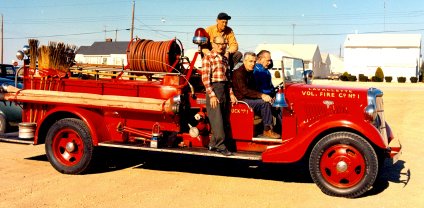
Company. A major project has been the restoration of the 1935 Ford
Fire Truck.
Dick Killick, Ed Reim, Ralph Anteau, and Charles Shubert in the 1935 Ford, 1977
In 1990 the Ladies Auxiliary of the Lavallette Volunteer Fire Company was organized as a support group of the Company. It assists in any fire emergency by providing food and beverages to the firefighters either at the scene or at the firehouse. It conducts several fund-raisers each year including taking pictures of people on the 1935 Ford apparatus during the Heritage Day festivities. It organizes the visits from Santa Claus and the Easter Bunny. The Auxiliary places a wreath at the Veterans' Memorial each year during the Memorial Day services and makes an annual donation to the Fire Company at its annual Installation Dinner.
The firehouse meeting room, besides being used for Fire Company business and as a polling place for elections, is used five days a week as a site for the Ocean County Nutrition Project.
The Lavallette Fire Company is a well equipped,
well-trained fire and rescue operation. Its growth and progress
have kept pace with the growth and progress of the Borough. Its
officers and members, along with constant in-service training, regularly
attend training courses to keep abreast of the latest firefighting
techniques. All new members must attend approved fire fighting
schools as a condition of membership. A plectron and pager system
provides instant communication, unaffected by power failures, to
each firefighter.
In 1996 the company was equipped with three fire engine pumpers, an emergency truck, a Ford pick-up truck for Fire Police, a Ford Expedition for use by the Chief and a jet ski. It has a boat rescue squad, and a scuba rescue team. In 1997 the Company received a new 1500 gallon E-One pumper. Its members stand ready twenty-four hours a day, year-round, to provide service and protection whenever called upon.
The Fire House in 1996

"The History of Lavallette,
Second Edition"
A work of the Lavallette Heritage Committee.
Available @
Borough Hall and the
Welcome Center / Badge Office

The Fire House in 2005

Propane Gas Grill
and Range Safety Tips
Propane Grill Do's
- Always use the grill outdoors in a well-ventilated area. Do not bring propane cylinders indoors or into an enclosed space such as a garage or basement.
- Always follow all of the manufacturer's instructions and keep written materials and manuals in a safe, accessible place.
- Make sure the grill burner controls are turned off. Keep the cylinder valve closed when not in use.
- Make sure the gas grill is shut off and cooled off before covering your grill after use.
-
Always use or store cylinders in an upright, vertical
position. Store them outdoors away from
sources of ignition. - When you have your cylinder refilled, have your supplier check for dents, damage, rust or leaks.
- After filling, take your cylinder home immediately. Keep your vehicle ventilated with the cylinder valve closed and plugged or capped. Do not leave the cylinder in your car.
- When your grill is not in use, cover disconnected hose-end fittings and burner air intakes with small plastic bags, or obtain protective fitting caps from your propane supplier to keep out dirt, insects and moisture.
- Before lighting your propane gas grill burner, use a leak-detection solution to check all connections for tightness. Contact your local propane gas supplier to obtain the leak-detection solution and instructions on how to use it.
- Never use matches or lighters to check for leaks.
If there is a significant and uncontrollable release
of gas or a fire,
Call
Propane Grill Don'ts
- Do not smoke while handling the propane cylinder.
- Do not leave the cylinder in your vehicle.
- Do not use matches or lighters to check for leaks.
- Do not allow children to tamper or play with the cylinder or grill.
- Do not use, store or transport your cylinder where it would be exposed to high temperatures. (This includes storing spare cylinders under or near the grill.)
Propane Gas Range Do's
- Follow the manufacturer's installation and operating instructions.
- Have your unit serviced if the burner flame is not blue. The blue flame indicates complete combustion. A yellow flame means air inlets are clogged or burners need to be adjusted.
- Keep pot handles turned inward.
- Schedule regular preventive maintenance checks for your appliances.
- Keep the range surface clean.
Propane Gas Range Don'ts
- Do not cover the oven bottom with foil - it can restrict air circulation.
- Never use gas ranges for space heating.
- Never allow children to turn the burner control knobs on your propane gas range.
- Do not leave food simmering unattended.
- Keep flammable materials away from burner flames.
For more safety information,
read the
latest CPSC fact sheet on safe grilling.
Also, the Hearth, Patio and Barbeque Association's Web
page
on grill safety
and trivia provides safety information about all types of grills.
Kitchen Fire Safety
With all that goes on in our lives, it's very easy to
forget that you placed that pan on the stove. It's a very common mistake.
You put something on the stove to cook. Then you get sidetracked. You
forget about it until the fire starts and the smoke alarm goes off.
If you're still home, you may have time to react. But if you've left
the house and the pan is still on the stove, you may not find out about
it until you return. By then, if you're lucky, your neighbors have noticed
your house is on fire and called the fire department!
The following
information describes the types of fires you might expect in the kitchen
... and what to do about them.
Dry Cooking Fires
The most common type of cooking fire is the dry cooking
fire. The water or moisture boils out of the pan and the food left in
the pan scorches, producing smoke. This usually doesn't cause a great
deal of damage. The heat may sometimes damage the surrounding area.
The smoke may leave a residue and an odor. Hopefully a little cleaning
up is all it takes.
Grease Fires
The grease fire occurs when oil or grease type foods
are heated and ignite. A grease fire can do significant damage. Open
flames can extend to surrounding cabinets or other combustible items.
If unnoticed, a grease fire can extend to a major house fire, engulfing
the entire kitchen, adjacent rooms or even the attic. This becomes a
dangerous life-threatening fire.
Oven Fires
Most of the time an oven fire is not serious. The fire is usually contained in the oven, which is designed for high heat anyway. The oven fire usually suffocates or is easily extinguished.
What to do if there is a kitchen fire.
- In all cases, make sure everyone evacuates the house.
- Call 911 and report the fire.
- If the fire is still very small, you can use a fire extinguisher to try and put it out. But if the fire gets out of control, get out of the house and wait for the fire department to arrive.
You might be able to extinguish a grease fire on
the stove in several different ways. The simplest way is to place a
lid on the pan and the fire should suffocate. A large amount of baking
soda can also be used to extinguish a grease fire. Once you have the
fire extinguished, don't forget to turn off the burner. But if the flames
are too high, don't risk getting burned.
Get out and call 911

Prevent Holiday
Fires
Family gatherings, entertaining, holiday decorations
-- these are but a few of the activities that make the winter holidays
so special and memorable. But each of these activities brings with it
an element of fire risk. Each year during the winter holiday season,
fires occur, often with tragic results. According to statistics available
from the National Fire Protection Association
,
an average of 11 deaths, 93 injuries, and $19.6 million in direct property
damage occur each year from Christmas trees that catch fire.
The leading causes of Christmas tree fires and property damage are short circuiting, ground faults, or other electrical failures.
As the holiday season again draws near, following these simple but effective fire prevention tips, both at work and at home, can minimize the possibility of a fire:
Fire Prevention Tips
- Use electrical items (such as lights or other holiday decorations) that are UL listed and in good condition. At work, check with your building manager to ensure electrical circuits will not be overloaded.
- Never place lights on a metallic tree or metal furniture such as a file cabinet.
- Always unplug the lights before leaving home or going to sleep.
- Never use candles to decorate a tree.
- At home, use extreme caution when burning candles. Be sure they are placed in sturdy, non-combustible holders, and are kept well away from decorations and other combustible materials. Check candles frequently to make sure they don't burn down too far or drip hot wax. Don't leave children unattended in a room with lit candles.
- Holiday decorations should be made with flame-retardant or non-combustible materials.
- Make sure your holiday tree is at least 3 feet from any heat source and placed so that it doesn't block an exit.
- If purchasing an artificial tree, be sure it is labeled as fire-retardant.
Should your workplace decide on a tree, check with fire or safety representatives to determine if it's permissible. If so, an artificial tree with a fire retardant/flame resistive certification by the manufacturer is recommended.
Holiday Tree Safety
- If you choose to use a natural cut trees in your work location, remember these critical points:
- Make sure it is fresh.
- Natural cut trees should be end-cut at an angle to help absorb water, placed in a suitable stand with adequate water. The water level should be checked daily and the tree removed upon evidence of dryness.
- Natural cut trees should not be permitted in assembly occupancies unless the building is fully covered by a sprinkler system.
- They should not obstruct any corridor, exit way, or other means of egress.
- They should not be located near heating vents or other fixed or portable heating devices that could cause the tree to dry out prematurely or to be ignited.
- Be aware that a dry tree is a serious fire hazard. If ignited, it will burn very quickly and with intense heat. Spraying or "flocking" a tree doe snot make it fire-resistive, so be careful. If your tree begins dropping needles, be sure to dispose of it safely. Dried-out trees are very dangerous.
Be Safe Not Sorry
- Holiday wrappings should be removed from the immediate area and discarded in a safe manner.
- As you are cleaning in preparation for your holiday decorating, take the opportunity to vacuum out the interior of your smoke detector. And don't forget to test your smoke detector monthly and make sure it has fresh batteries.
- How old is your smoke detector? The
National Fire Protection
Association
recommends that smoke detectors be replaced every 10 years. - Use care when disposing of smoking materials. Cigarette butts can smolder if not completely doused in water before disposal. The same is true of fireplace ashes, which can smolder for up to two weeks after a fire.
- By considering these simple rules, you can minimize the possibility of a fire at work or at home.
Living in a home
without smoke detectors is risky business!
When fire occurs in your home, your chances for survival
are two times better when smoke detectors are present than when they
are not.
Smoke detectors, when properly installed and maintained
(following the manufacturer's directions), provide early warning when
fires occur. Early warning increases your chances for survival and allows
the fire department to save more of your property.
In support
of smoke detector effectiveness, many cities and states have laws requiring
the installation of smoke detectors in dwellings. Check with your local
fire department or State Fire Marshal for further information.
Time is crucial. Most fatal fires occur between midnight and 8 a.m.
Many fire victims die in their sleep from breathing smoke and toxic
fire gases. When your smoke detector sounds, you may have 2-1/2 minutes
or less to escape. Develop and Practice a Home Escape Plan.
Installation of smoke detectors
Electric smoke detectors should be connected to a lighting
circuit with no intervening switches. For this, you may need an electrician.
Connections using extension-type cords are not permitted.
Battery-operated models should sound an alert or beeping
sound when batteries need replacing. A smoke detector with dead batteries
or whose batteries have been removed is no protection at all.
Dual-power models are available which are electrically
powered but contain a battery back-up should there be a power failure.
Use only those detectors bearing the label of Underwriters
Laboratories (UL) or Factory Mutual (FM). The ceiling is the best mounting
location at least six inches away from any walls. If detectors are mounted
on the wall, keep them away from corners and at least 6 inches, but
no more than 12 inches, from the ceiling to the bottom of the detector.
Help save your life and property from fire
For minimum protection, install a smoke detector outside each bedroom or sleeping area in your home and keep your bedroom doors closed while you are asleep.
Keep your smoke detectors properly maintained. Test them at least once each month to insure that the detectors are working properly. Batteries in battery-operated detectors should be changed at least once yearly. Use only the type of batteries recommended on the detector.
If your smoke detector sounds an alarm when no smoke is present, consult with the manufacturer or with your local fire department. If smoke from cooking materials causes the detector to alarm, do not remove the batteries or disconnect the power source. Simply fan the smoke away from the detector until the alarm stops. If this happens frequently, it may be necessary to relocate the detector or to install a different type of detector.
Develop an escape plan and review the plan with all members of the family frequently. Be aware that children and elderly people may need special assistance should fire occur. Establish a meeting place outside the house for all members of the family to ensure that everyone gets out of the house. Use a neighbor's telephone to notify the fire department.
Additional tips
If your smoke detector doesn't work properly, the silence could be deadly.
Test your smoke detector at least once a month. Push the test button or use smoke.
Clean your detector at least once a year. Dust with a vacuum cleaner.
Replace the battery each year. Use the battery type listed on the detector.
Fire Extinguishers

How to Use a Fire Extinguisher
Even though extinguishers come in a number of shapes and sizes, they all operate in a similar manner. Here's an easy acronym for fire extinguisher use:
P A S S -- Pull, Aim, Squeeze, and Sweep
Pull
the pin at the top of the
extinguisher that keeps the handle from being accidentally pressed.
Aim
the nozzle toward the base
of the fire.
Squeeze
the handle to discharge
the extinguisher standing approximately 8 feet away from the fire and
. If you release the handle, the discharge will stop.
Sweep
the nozzle back and forth at the
base of the fire. After the fire appears to be out, watch it carefully
since it may re-ignite!
Class A Extinguishers will put out fires in ordinary combustibles, such as wood and paper. The numerical rating for this class of fire extinguisher refers to the amount of water the fire extinguisher holds and the amount of fire it will extinguish.
Class B Extinguishers should be used on fires involving flammable liquids, such as grease, gasoline, oil, etc. The numerical rating for this class of fire extinguisher states the approximate number of square feet of a flammable liquid fire that a non-expert person can expect to extinguish.
Class C Extinguishers are suitable for use on electrically energized fires. This class of fire extinguishers does not have a numerical rating. The presence of the letter “C” indicates that the extinguishing agent is non-conductive.
Class D Extinguishers are designed for use on flammable metals and are often specific for the type of metal in question. There is no picture designator for Class D extinguishers. These extinguishers generally have no rating nor are they given a multi-purpose rating for use on other types of fires.
Turkey Fryers
Safety Tips
From Underwriters Laboratories
A longtime food favorite in the southern United States, the delicious deep-fried turkey has quickly grown in popularity thanks to celebrity chefs such as Martha Stewart and Emeril Lagasse. While some people rave about this tasty creation, Underwriters Laboratories Inc.'s (UL) safety experts are concerned that backyard chefs may be sacrificing safety for good taste.
"We're worried by the increasing reports of fires related with turkey fryer use," says John Drengenberg, UL consumer affairs manager. "Based on our test findings, the fryers used to produce those great-tasting birds are not worth the risks. And, as a result of these tests, UL has decided not to certify any turkey fryers with our trusted UL Mark."
Here's why using a deep-fryer can be dangerous:
Many units easily tip over, spilling the hot oil within the cooking pot.
If the cooking pot is overfilled with oil, the oil may spill out of the unit when the turkey is placed into the cooking pot. Oil may hit the burner/flames causing a fire to engulf the entire unit.
Partially frozen turkeys placed into the fryer can cause a spillover effect. This too, may result in an extensive fire.
With no thermostat controls, the units also have the potential to overheat the oil to the point of combustion.
The sides of the cooking pot, lid and pot handles get dangerously hot, posing severe burn hazards.
If you absolutely must use a turkey fryer,
here are
some tips for safer use:
Turkey fryers should always be used outdoors a safe distance from buildings and any other material that can burn.
Never use turkey fryers on wooden decks or in garages.
Make sure the fryers are used on a flat surface to reduce accidental tipping.
Never leave the fryer unattended. Most units do not have thermostat controls. If you don't watch the fryer carefully, the oil will continue to heat until it catches fire.
Never let children or pets near the fryer when in use. Even after use, never allow children or pets near the turkey fryer. The oil inside the cooking pot can remain dangerously hot, hours after use.
To avoid oil spillover, do not overfill the fryer.
Use well-insulated potholders or oven mitts when touching pot or lid handles. If possible, wear safety goggles to protect your eyes from oil splatter.
Make sure the turkey is completely thawed and be careful with marinades. Oil and water don't mix, and water causes oil to spill over, causing a fire or even an explosion hazard.
The National Turkey Federation recommends refrigerator thawing and to allow approximately 24 hours for every five pounds of bird thawed in the refrigerator.
Keep an all-purpose fire extinguisher nearby. Never use water to extinguish a grease fire. Remember to use your best judgment when attempting to fight a fire. If the fire is manageable, use an all-purpose fire extinguisher. If the fire increases, immediately call 9-1-1 for help.